High paper archive management cost
Monthly per-elevator paper record organization, pre-inspection rush to fill gaps — high risk of missing items and signatures.
Industry Scenarios
Status monitoring + digital work orders + auto-archived maintenance records
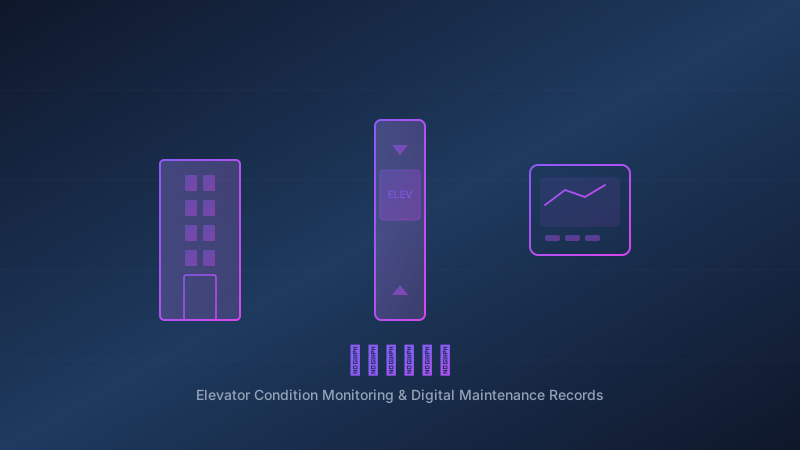
For elevator maintenance companies: Online elevator operational status monitoring, anomaly alerts + digital maintenance work orders, auto-archived maintenance records to meet regulatory inspections and reduce passive owner-reported breakdowns.
Primary Contact: Elevator Maintenance Company GM / Technical Director / Maintenance Station Manager
Monthly per-elevator paper record organization, pre-inspection rush to fill gaps — high risk of missing items and signatures.
Entrapments and unusual noises only known when owners report — response time and service reputation both damaged simultaneously.
No objective records of whether technicians arrived on time and performed items as specified. Management relies solely on person-to-person supervision.
As elevator count grows, archive and scheduling management pressure increases linearly. Profits eaten by management personnel costs.
Elevator operational status acquisition, AI abnormal condition identification, fault pre-warning + maintenance work order management, supporting elevator maintenance digitalization.
Motor, pump, compressor status acquisition, vibration and temperature runtime monitoring, predictive maintenance.
Universal IoT foundation, multi-type sensor connectivity, unified device management, time-series storage, alerting engine.
The following AI capabilities are available upon platform activation — no additional deployment or configuration required.
Automatically detects anomalies against equipment baselines, supports vibration spectrum analysis, temperature trend alerts, and energy anomaly detection with continuously improving accuracy.
Collects 7–14 days of normal operation data to automatically generate per-device health baselines with visualized degradation trends.
Automatically generates diagnostic reports upon alert triggers, including waveform snapshots, spectrum analysis, suspected fault causes and suggested actions, with PDF export and sharing support.
Alerts automatically generate work orders pushed to assigned operators, with progress tracking and repair record archiving for a complete equipment maintenance history.
These factors determine whether the project can be successfully delivered — confirm during the initiation phase.
Pilot recommended on 1–3 elevators. First verify stable data acquisition from third-party DTU and alert specifications.
Hardware: customer independently procures third-party acquisition devices. We only provide the software platform and connectivity integration.
All external communications and contracts must clearly state: "Maintenance assistance monitoring; does not assume special equipment safety responsibility."
Alerts must be pushed to the corresponding maintenance technician per elevator assignment. Misrouting will quickly erode field trust in the system.
The following is a typical workflow. Actual scheduling is confirmed during the solution phase based on site conditions.
Engineer confirms equipment list, gateway location, power supply and signal conditions — remotely or on-site.
SIM card activation and gateway installation — plug-and-power, no downtime or cabling.
Remote device data onboarding, verifying data quality per point, flagging anomalous points for re-inspection.
Equipment operates normally for 7–14 days while AI learns baseline patterns. System runs silently with no alerts during this phase.
Activate alert push, jointly validate alert accuracy and work order workflow with client O&M team, fine-tune alert rules based on feedback.
Fill in the form below. A technical consultant will contact you on the same business day with equipment monitoring recommendations and a pricing range tailored to your site conditions.